What Is on This Page
- Why Mobile Home Demolition Is Different
- The Mobile Home Demolition Process Step by Step
- What Mobile Home Demolition Costs in Bay County
- Choosing the Right Dumpster for Mobile Home Cleanup
- Local Considerations for Bay County Mobile Home Demolition
- Tips for a Smooth Mobile Home Demolition
- Frequently Asked Questions
Tearing down a mobile home is rarely the kind of job you tackle on a whim. Maybe you inherited a property in Panama City with an aging single-wide that no longer makes sense to renovate. Maybe a hurricane finally made the decision for you on a unit in Mexico Beach. Or maybe a manufactured home in Lynn Haven is sitting on land you’d rather see cleared for a new build. Whatever the reason, mobile home demolition is its own animal — different from a stick-built tear-down, different from a shed removal, and different from concrete work.
This guide walks Bay County homeowners, landlords, and contractors through what to expect when a mobile home comes down: how the demolition itself works, what it tends to cost, what size dumpster you need for the cleanup, and the local factors that shape the timeline. Whether you’re hiring out the whole job or handling parts of the cleanup yourself, the goal is the same — a level lot, properly disposed debris, and no surprises along the way.
Why Mobile Home Demolition Is Different
Manufactured housing isn’t built like a traditional home, and that changes the demolition entirely. The floor system sits on a steel chassis with axles and tongue still attached or removed long ago. Walls are framed with thinner lumber and stitched together with paneling and metal skin rather than the dimensional studs and drywall of a conventional house. Roofs are typically lower-pitch, often metal-clad, and tied to the chassis with long anchor straps that run the full height of the unit.
A few practical implications follow from all of that. First, the materials separate differently — a mobile home produces a higher ratio of metal to wood than a stick-built tear-down, which affects both salvage value and how you stage your debris piles. Second, older units carry materials that need careful handling: pre-1976 homes (built before HUD’s manufactured housing standards) may contain asbestos in vinyl flooring, insulation, or duct wrap, and lead paint isn’t unheard of in interiors painted before the late 1970s. Third, anchoring systems — concrete piers, ground anchors, tie-down straps — all have to come out as part of the job, not just the structure above the floor.
The Dumpster Guy handles mobile home removal across Bay County as part of our full demolition service line, which means we manage the assessment, the utility disconnects, the structural breakdown, and the debris haul-off as one project. That keeps the timeline tight and the lot ready for whatever comes next, whether that’s a new build, a replacement unit, or a clean piece of land to sell.
The Mobile Home Demolition Process Step by Step
Most mobile home demolitions move through the same general sequence. Knowing each phase ahead of time helps you plan the timeline, line up dumpsters at the right moments, and avoid the kind of mid-project surprises that add cost.
Step 1: Site Assessment and Permitting
Every job starts with a walk-through. The crew documents the home’s age, size (single-wide, double-wide, or triple-wide), construction era, and condition. Lot access is mapped — how big a truck can fit, where the dumpster can stage, and whether any trees, fences, or utility lines will be in the way. Bay County and the incorporated municipalities each handle demolition permits a little differently, so this is also when paperwork gets pulled. A reputable demolition contractor handles permits as part of the scope; if you’re going DIY on a small unit, call the county building department before you start.
Step 2: Utility Disconnection
Power, water, sewer or septic, and propane all have to be properly shut down and capped before any structure comes apart. Power gets disconnected at the meter and the line is removed by the utility. Water is shut at the meter or well head and capped at the home. Sewer connections are closed at the cleanout, and septic tanks are pumped, crushed, or filled per local code. Propane tanks are emptied and removed by a licensed handler.
Step 3: Soft Strip
Before the structure comes down, the easy stuff comes out. Skirting (vinyl or aluminum) is pulled. Decks, porches, awnings, and steps are dismantled. Window AC units, exterior lights, and condensers come off. Anything inside that can be salvaged or sold — appliances, fixtures, copper plumbing, cabinetry — gets pulled at this stage. The soft strip phase is where a smaller dumpster earns its keep, because a lot of mixed lightweight debris piles up fast.
Step 4: Structural Breakdown
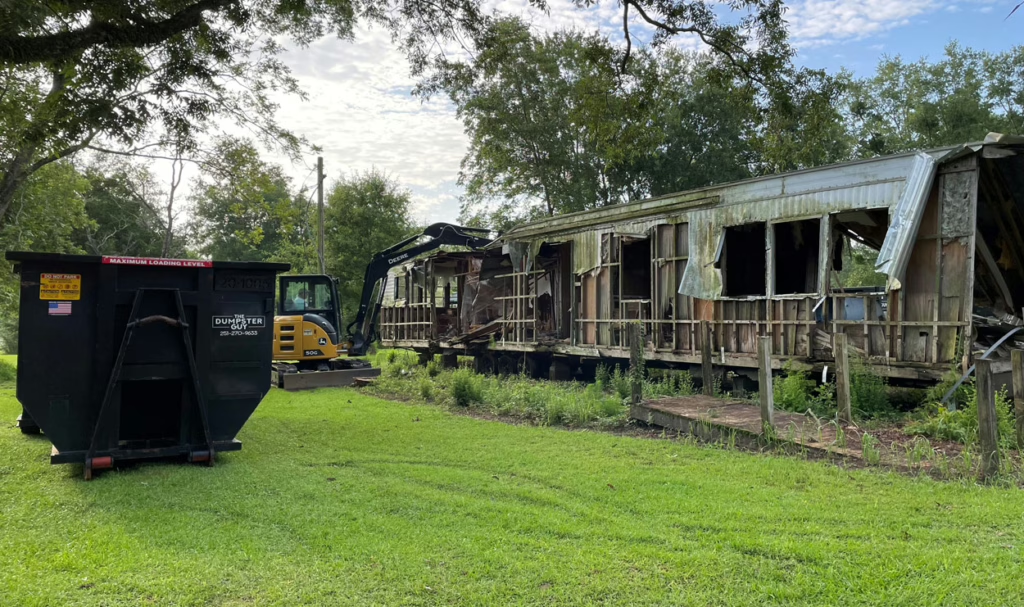
The roof and walls come down next. On most single-wides, the crew separates the roof skin and decking, brings the walls in toward the center, and cuts the steel chassis free as the heaviest single piece. A double-wide gets handled in halves, since the unit was originally delivered in two sections. Heavy equipment — typically a small excavator with a thumb attachment — does most of the work here, with the crew sorting steel from wood and other debris as the structure comes apart.
Step 5: Foundation, Anchors, and Site Restoration
Once the structure is gone, the supporting elements come out: concrete piers, ground anchors, tie-down straps, and any concrete pads or aprons. Skirting framing usually pulls with the structure, but masonry or concrete skirting takes its own pass with concrete-rated equipment. After everything is hauled off, the lot is graded clean, low spots are filled, and the site is ready for whatever comes next.
Step 6: Final Debris Haul
The final step is making sure every yard of debris leaves the property and lands somewhere appropriate. Steel goes to scrap. Clean wood may go to a separate facility. Mixed construction and demolition debris goes to a permitted C&D landfill. Any hazardous materials identified in the assessment go through the right disposal channel — never the regular dumpster.
What Mobile Home Demolition Costs in Bay County
Pricing on a mobile home demolition varies more than most people expect, because the variables stack: size, age, condition, lot access, asbestos status, and how the disposal is handled all push the number up or down. That said, here are the cost factors worth understanding before you call for a quote.
Unit Size – A single-wide takes roughly half the labor and produces roughly half the debris of a double-wide, so it’s the cheapest scenario. Triple-wides are uncommon in Bay County but do exist, and they price closer to a small site-built home demolition.
Age and Materials – Pre-1976 units may require asbestos testing and, if positive, abatement before demolition. Abatement adds meaningful cost but is non-negotiable. Newer manufactured homes built to HUD code rarely run into that issue.
Lot Access – A unit on a flat, open lot with truck access from a paved road is the easy case. Tight rural lots with soft ground, narrow approaches, or surrounding structures take longer and sometimes require smaller equipment, which slows the breakdown phase.
Foundation Type – A unit sitting on concrete piers comes off relatively cleanly. A unit on a concrete runner or full pad adds concrete demolition time. Buried tie-downs add a small amount of excavation.
Disposal Distance – Bay County has C&D disposal options closer to Panama City and the urban core; rural jobs in Fountain or Youngstown are still well-served, but the haul distance is part of the pricing.
For an itemized quote on your specific unit and lot, the fastest path is a phone call. We’ll walk through the assessment over the phone in a few minutes and get out for a site visit if it’s a more complex job. For current dumpster pricing if you’re handling part of the cleanup yourself, see our dumpster rental prices page.
Choosing the Right Dumpster for Mobile Home Cleanup
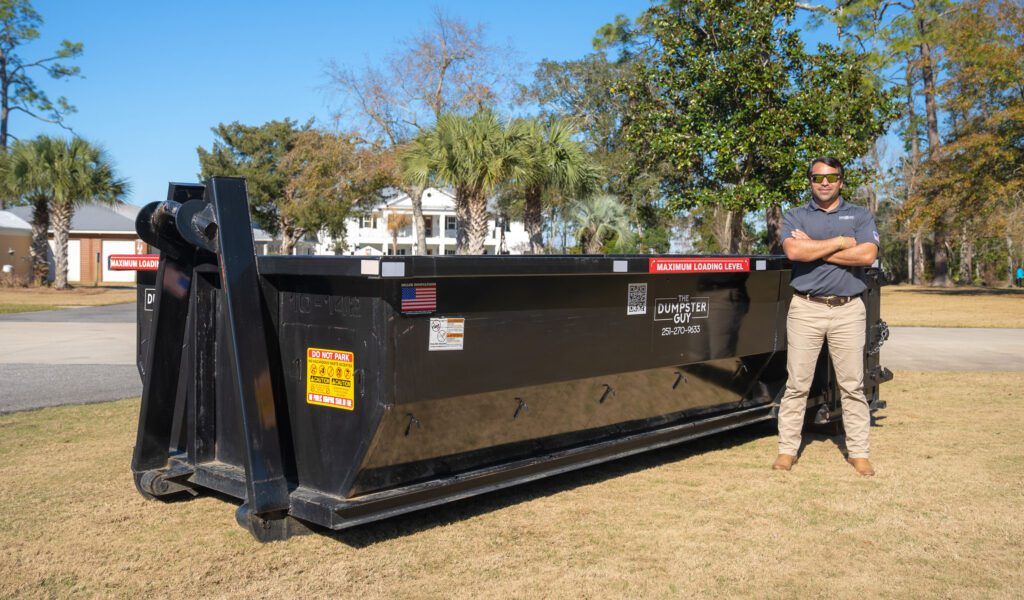
Even on jobs where a demolition crew handles the heavy work, a roll-off dumpster usually still has a role to play — for the soft strip, the post-demo cleanup, or for owner-handled portions of the project. Mobile homes also generate more debris volume than people expect: a single-wide can easily produce 12 to 18 cubic yards once metal is separated, and a double-wide can run 25 to 35 yards or more. Sizing the dumpster correctly the first time keeps the project moving and the cost predictable. We offer three container sizes to match different stages of the work.
10-Yard Dumpster – $375
The 10-yard container holds about three pickup truck loads of material and fits comfortably in most residential driveways. For mobile home work it’s the right call when you’re doing the soft strip ahead of a demolition crew — pulling skirting, breaking down decks and steps, hauling out interior contents, or finishing site cleanup after the structure is already gone. It’s also the preferred size when access is tight or driveway space is limited.
15-Yard Dumpster – $425
The 15-yard offers a solid middle ground when the project is bigger than a soft strip but smaller than a full structural teardown. It’s a good fit for demolishing porches, attached additions, sheds, and outbuildings that came with an older mobile home — the kind of pre-demo work that can run into more debris than a 10-yard handles cleanly. Many Callaway and Parker homeowners default to this size for renovation-style projects on rural mobile home lots.
20-Yard Dumpster – $475
The 20-yard is our largest size and the one we recommend for the structural debris from a single-wide demolition or for the back end of a double-wide cleanup. There’s enough capacity for framing, paneling, insulation, roofing, and the mixed materials that come off a mobile home once the metal is separated out. Most full mobile home demolitions use more than one 20-yard load, either swapped back-to-back or sequenced with a smaller container at the soft-strip stage.
Tell us what stage of the project you’re at and we’ll help you sequence the right size at the right moment so you’re not paying for capacity you don’t need.
Local Considerations for Bay County Mobile Home Demolition
Bay County’s mix of coastal, suburban, and rural communities creates real differences in how mobile home demolitions play out. Knowing the local context up front helps the project move on schedule.
Coastal and Beach Communities
Mobile homes along the coast in Panama City Beach and Mexico Beach often come with extra layers — HOA paperwork, association rules around dumpster placement, and storm-related water damage that adds to the disposal weight. Storm-damaged units are common after hurricane season, and the wet drywall, soaked insulation, and saturated subflooring can push a unit’s debris weight well above what a dry teardown would produce. Plan for an extra dumpster or oversize the structural roll-off if the unit took on water.
Suburban and Urban Neighborhoods
Lots in Panama City, Lynn Haven, Springfield, and Upper Grand Lagoon are typically tighter than rural Bay County lots, which means staging the dumpster, the truck, and the equipment all in one workable footprint takes coordination. Driveway placement is usually possible; street placement may require a permit from the city. Demolitions in these areas also tend to be infill-driven — older single-wides being removed to make way for new builds — so the cleanup needs to leave the lot truly buildable, not just empty.
Northern and Rural Bay County
Mobile home work in Fountain, Youngstown, and the surrounding rural areas usually has more breathing room — bigger lots, more flexible dumpster placement, and easier equipment staging. The trade-off is soft ground after rain, longer haul distances to disposal, and well/septic disconnects rather than municipal utility shutoffs. Rural demolitions also more frequently include outbuildings, sheds, and old fencing in the same scope, which can be folded into one project if planned together.
Tips for a Smooth Mobile Home Demolition
A handful of decisions before the first dumpster lands will save you days on the back end.
Test before you tear. If the unit was built before the late 1970s, get an asbestos and lead paint inspection before any demolition starts. Testing is inexpensive compared to a stop-work order or an emergency abatement on a job that’s already underway.
Separate the metal early. The chassis, frame steel, and exterior skin all have salvage value and don’t belong in your dumpster. Pull a scrap hauler in first or stage a separate metal pile so the C&D dumpster only carries debris that actually has to be paid to dispose of.
Stage on a hard surface. Driveways, gravel pads, or compacted dirt all work for a dumpster. Soft sand and wet grass under a heavy load are how you end up with ruts, towed trucks, and a frustrated homeowner.
Document the unit before demolition. Photographs of the home, the address, and any HUD label are useful for the title cancellation paperwork that Florida requires after a mobile home is destroyed. Take the photos before the structure comes down.
Plan the order of operations. Soft strip first, then structure, then foundation, then site grading. Trying to compress steps to save time tends to create staging problems and double-handling of debris.
Coordinate dumpster swaps with the demolition timeline. A roll-off sitting on the lot for a week without being filled is wasted budget; a full container holding up the next phase of demo is wasted time. Sequence the swaps with the crew schedule.
Confirm the title is canceled after. In Florida, a destroyed mobile home requires a Form HSMV 82109 to retire the title. This step is often forgotten and creates problems later for the property owner.
Frequently Asked Questions
How long does a mobile home demolition take?
Most single-wides come down in one to two days on site once the assessment, permitting, and utility disconnects are complete. Double-wides typically take two to three days. The pre-demo phase — paperwork, utility shutoffs, asbestos testing if needed — can add days to weeks depending on the unit’s age and the local permitting timeline.
Do I need a permit to demolish a mobile home in Bay County?
Yes. Bay County and the incorporated cities require a demolition permit before the structure comes down. A licensed demolition contractor handles the permit as part of the scope. If you’re tackling parts of the project yourself, contact the county building department or your city before any demolition work begins.
Can I demolish my own mobile home?
You can handle the soft strip and parts of the cleanup yourself, but the structural demolition itself usually requires equipment and disposal access most homeowners don’t have. Even DIY portions still need a permit and proper utility disconnects. Most owners handle the soft strip and contents removal, then bring in a contractor for the actual teardown.
What’s the difference between mobile home removal and demolition?
Removal can mean either physically transporting the unit to a new location or demolishing and hauling it away. In most Bay County cases — especially with older or damaged units — the home isn’t worth moving, so removal and demolition end up being the same job: tearing it down and disposing of the debris.
What size dumpster do I need for a single-wide demolition?
Most single-wide demolitions use one or two 20-yard roll-offs for structural debris, plus a 10-yard for the soft strip and post-demo cleanup. Total volume is typically 12 to 18 cubic yards once metal is separated, but wet or storm-damaged units run heavier and may need extra capacity.
Can I put the metal chassis in the dumpster?
You can, but it’s almost always better to separate it. Steel has scrap value and a scrap yard will often pay you for the chassis instead of the disposal facility charging you to throw it away. Pulling a scrap hauler before the C&D haul saves real money on most mobile home jobs.
How do I cancel the title after demolition?
In Florida, a destroyed mobile home requires submission of Form HSMV 82109 to retire the title. Your demolition contractor or the county tax collector’s office can walk you through the paperwork.
Do you handle mobile home demolition for landlords and investors?
Yes. We work regularly with property owners, real estate investors, and landlords across Bay County who need older or damaged units cleared from rental lots, inherited properties, or land being prepared for sale or new construction. Multi-unit jobs and ongoing relationships are welcome.
Ready to Schedule Your Mobile Home Demolition?
Mobile home demolition is the kind of project that goes smoothly when it’s planned right and turns into a headache when it isn’t. The Dumpster Guy handles the full scope — assessment, permits, utility disconnects, structural breakdown, and final site grading — and we deliver roll-off dumpsters across Bay County for the cleanup phase, whether you’re hiring out the demolition or handling parts of it yourself. From Panama City to Mexico Beach to the rural communities up north, we know the local landscape and how to keep these jobs on schedule.
Visit our dumpster rental FAQ page for additional information or contact us to get a quote on the demolition, the dumpster, or both.
Related Reading: